Jaw Botox (Masseter Botox / jaw reduction): who is it for, and when do results appear?
Jaw Botox is an injection of Botulinum Toxin into the masseter muscles to reduce the activity of the jaw muscles. It suits people whose jaw prominence comes from muscle rather than bone. Changes begin in about 2–4 weeks, full effect comes around 6–8 weeks, and results vary by individual.
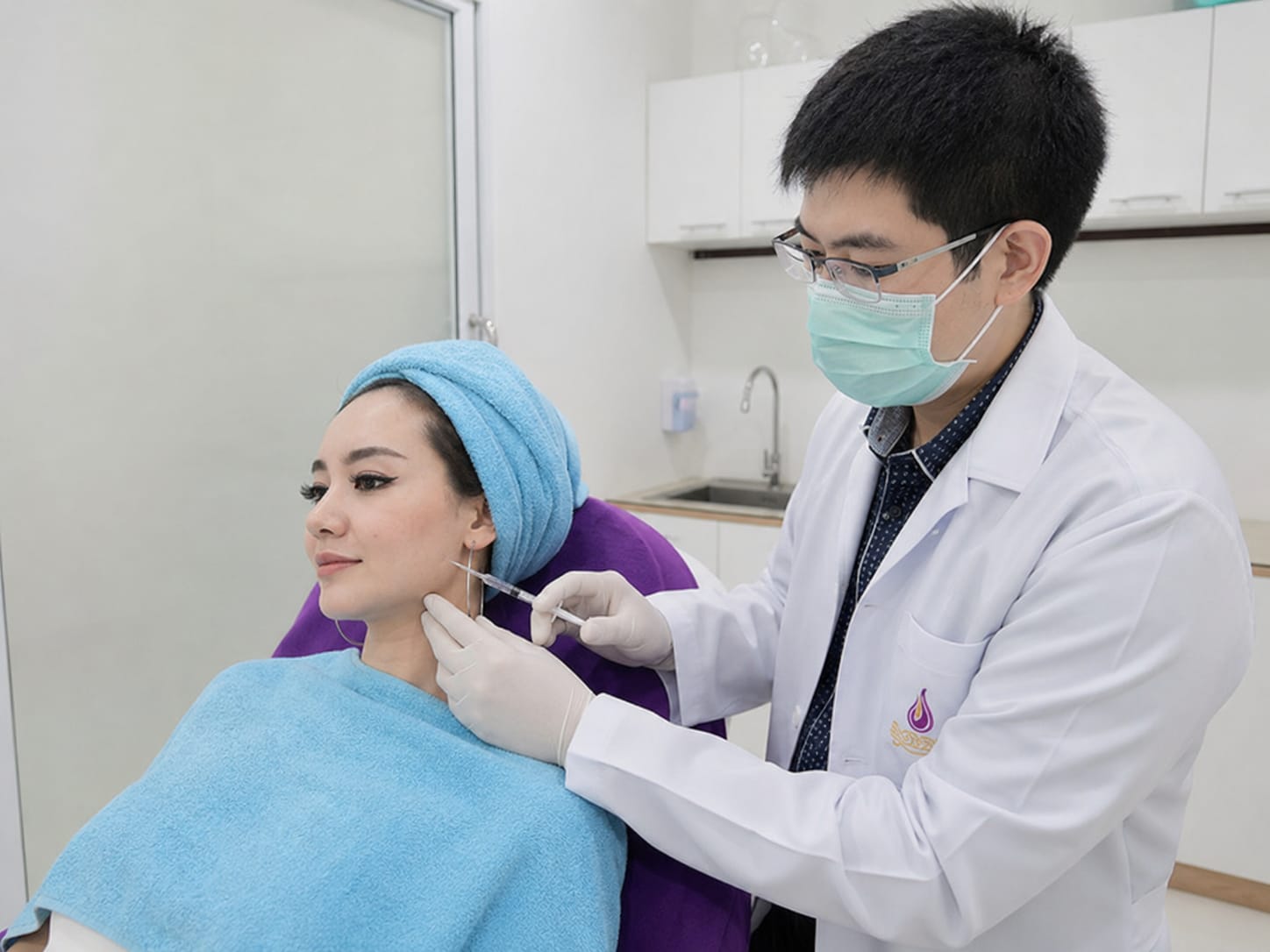
In brief: what is jaw Botox and how does it slim the jaw?
Jaw Botox (Masseter Botox / jaw reduction) is an injection of Botulinum Toxin into the masseter muscle (Masseter Muscle) at the jaw to reduce muscle activity. When the muscle is used less over 4–8 weeks, its size gradually decreases, so the lower face looks naturally slimmer without surgery. Results last about 4–6 months. It suits people whose wide jaw comes from muscle.
Reviewed by Dr. Net (หมอเน็ท) · Medical license ว.56133 · Updated 2026-10
Treatment overview
The masseter is an important muscle used for chewing and clenching the teeth, located at the sides of the jaw. If this muscle is large due to genetics, constant teeth clenching, or grinding during sleep (Bruxism), the lower face can look wide and square.
Jaw Botox uses the same principle as wrinkle-reduction Botox — blocking the signals between nerves and muscles — but with a different goal. Jaw Botox does not aim to reduce wrinkles; it aims to reduce muscle size. When the muscle works less over several weeks, its size gradually decreases.
Beyond facial contouring, jaw Botox may also reduce bite force or certain symptoms related to teeth grinding in some people, because the masseter works less. At Sanambinnam Clinic (คลินิกสนามบินน้ำ), the physician assesses muscle size, jaw structure, and symptom history before planning an appropriate injection.
Suitable for
- People with genetically large masseter muscles that make the face look wide and square
- People who habitually clench or grind their teeth, enlarging the masseter muscles
- People with sleep grinding (Bruxism) who want the physician to assess bite force or jaw pain
- People who want a slimmer face without surgery
- People whose face is asymmetric because one masseter is larger than the other
- People who want to trial jaw contouring before considering surgery
Consult a physician first / not suitable for
- People who are pregnant or breastfeeding
- People with a muscle weakness disease (Myasthenia Gravis) or Eaton-Lambert syndrome
- People who are allergic to Botox components
- People with an infection on the face
- People whose jaw is wide from bone structure more than muscle may need to consider other approaches
- People taking Aminoglycoside medications should inform the physician
What the physician assesses before jaw Botox
- 1 The size and shape of both masseter muscles, by asking you to clench so the muscles engage, then palpating their size
- 2 The jawbone structure, to see whether the issue comes from muscle or bone
- 3 The symmetry of both masseter muscles, to plan the appropriate amount on each side
- 4 Teeth clenching or grinding habits, to assess whether Bruxism is present
- 5 Health history, current medications, and allergy history
- 6 The patient’s expectations, to explain the realistically possible scope of results
Getting jaw Botox near Sanambinnam, Nonthaburi: what should be assessed?
For people near Sanambinnam, Ngamwongwan, Khae Rai, or Mueang Nonthaburi, the pre-injection assessment should clearly distinguish whether the jaw prominence comes from muscle, bone, or fat, because each cause needs a different approach.
At Sanambinnam Clinic, the physician asks you to clench to palpate the masseter muscles, checks facial symmetry, and asks about clenching or jaw-pain history before planning the dose and the injection points.
Jaw Botox procedure steps
Assess the masseter muscles
The physician asks you to clench so the masseter muscles engage, then palpates and assesses the size of both sides.
Cleanse and mark the points
The jaw area is cleansed and the injection points are marked on the masseter; ice may be used to reduce discomfort.
Botox injection
Botox is injected into the masseter at 3–5 points per side, according to the planned positions; it takes about 15–20 minutes.
Assessment and aftercare advice
The physician assesses the initial result, gives aftercare instructions, and books a follow-up at 4–6 weeks.
Timeline and expected results
| Timeframe | Expected results |
|---|---|
| First 2–4 weeks | The masseter starts to relax and clenching feels weaker |
| 6–8 weeks | Full effect in many cases; the masseter may look smaller and the face frame changes according to the response |
| 4–6 months | The effect gradually returns to normal as the muscle works again |
| Procedure time | About 15–20 minutes |
How long jaw Botox results last
Jaw Botox results last about 4–6 months, depending on the amount injected, each person’s metabolism, and behaviours such as teeth clenching habits, which make the muscle work hard and can wear the effect off faster. Some people who inject consistently over several sessions may find the effect lasts slightly longer in the long term, as the muscle becomes progressively smaller. Results vary by individual.
Risks and side effects
Common (temporary)
- Slight pain or discomfort during injection
- Minor bruising at the injection site
- Slight weakness or soreness when chewing food at first
- Mild swelling or redness
Less common
- Incomplete smile (if the product spreads to the muscles around the mouth)
- Unusual difficulty or weakness when chewing
- Facial asymmetry (if the amounts on the two sides differ)
- Allergic reactions, rash, or inflammation
Why do hollow-looking cheeks or a crooked smile happen after jaw Botox?
An incomplete smile or cheeks that look hollow when smiling is mostly caused by the product spreading to the muscles around the mouth, which sit near the jaw muscles. It can happen if the injection is placed too high or the amount is too large in someone with a small jaw. Other common causes are injecting unequal amounts on the two sides, or pre-existing dental protrusion that already made the jaw shape asymmetric.
Symptoms to watch for, and how long they usually take to resolve on their own
| Symptom | Common cause | Usual time to resolve on its own |
|---|---|---|
| Incomplete smile; hollow-looking cheeks when smiling | Product spread to the muscles around the mouth, or injection placed too high / amount too large | 2–8 weeks, depending on how far the product spreads |
| Difficulty chewing; weak chewing | The jaw muscles are not yet at full strength in the early period | 2–6 weeks as the product level decreases |
| Jaw smaller on one side | Unequal amounts between the two sides, or muscles responding differently | Needs a physician assessment — do not wait for it to resolve on its own |
| Gummy smile; teeth touching | A naturally small jaw, or dental protrusion | A structural trait, not a side effect of the product |
How to prevent it
- Have the physician assess your bite and your smile before every injection. People with dental protrusion or a gummy smile need the injection points and amounts adjusted to their actual structure.
- Choose the amount and positions based on each person’s jaw thickness — never use a fixed dose, especially for small jaws or first-time patients.
- Inject both sides symmetrically, and book a review 2 weeks after treatment.
- If hollow-looking cheeks or a crooked smile appear after treatment, tell the clinic and book a physician visit; most cases can be managed by waiting or adjusting the amount at the next appointment.
Jaw Botox compared with other methods
| Option | Principle | Duration of effect | Suitable for |
|---|---|---|---|
| Jaw Botox | Reduces masseter contraction so the muscle becomes smaller | 4–6 months | Wide jaw from large muscles; teeth grinding |
| Mesofat | Injects a fat-dissolving substance into areas with fat deposits | Several sessions | Fat deposits under the chin, cheeks, jaw |
| Jaw surgery | Cuts the jawbone or repositions the jawbone | Permanent | Wide jaw from structural bone |
Frequently asked questions
What is jaw Botox?
Jaw Botox is the injection of Botulinum Toxin Type A into the masseter muscle (Masseter Muscle) in the lower cheek area to reduce muscle contraction. The muscle becomes smaller and the face looks slimmer. It is approved by the Thai FDA for medical and aesthetic use.
When do jaw Botox results appear?
Results usually start to appear about 2–4 weeks after injection, as the masseter begins to shrink and the face looks slimmer. Full effect comes at 6–8 weeks. The result lasts about 4–6 months.
Does jaw Botox really make the face slimmer?
Jaw Botox reduces the size of the masseter muscle, which sits at the sides of the jaw, making the lower face look slimmer. This effect is clearest in people whose masseter muscles are large due to genetics or habits such as teeth clenching or grinding. Results vary by individual.
How is jaw Botox different from Mesofat?
Jaw Botox reduces the size of the masseter muscle, slimming the face by reducing muscle, while Mesofat injects a fat-dissolving substance into areas with fat deposits, such as under the chin, the cheeks, or the jaw. The two target different things, but they are often combined to slim facial proportions naturally.
Can I chew food normally after jaw Botox?
Yes, as usual. Jaw Botox does not affect the muscles used for chewing food, though you may feel slight soreness at first after the injection. If you are taking certain medications, inform the physician before treatment.
For a wide jaw, is Botox enough or is surgery needed?
It depends on the cause of the wide jaw. If it comes from an enlarged masseter muscle, Botox may be enough. If it comes from a prominent jawbone or a structurally wide frame, jaw surgery may need to be considered. The physician will assess and recommend the suitable approach.
Related answers from the doctor
Related treatments
Book a jaw Botox consultation
Sanambinnam Clinic — 421 Ngamwongwan Road, Bang Khen, Mueang Nonthaburi, Nonthaburi 11000
Call for inquiries/appointments: 086-464-2410
💬 LINE: @clinicsanambinnam
The clinic is open daily 10:30–20:00
The content on this page is provided for educational purposes only. Actual treatment must be under a physician’s assessment. Results vary by individual.